4. Transformative Photo:
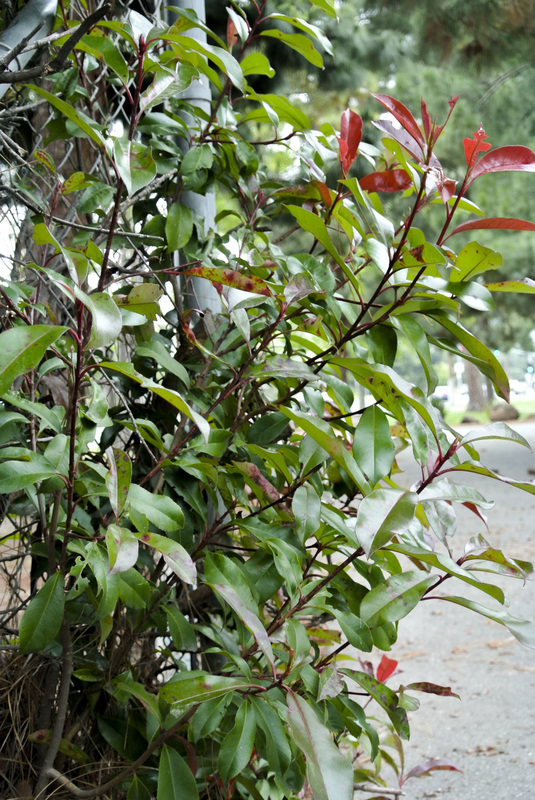
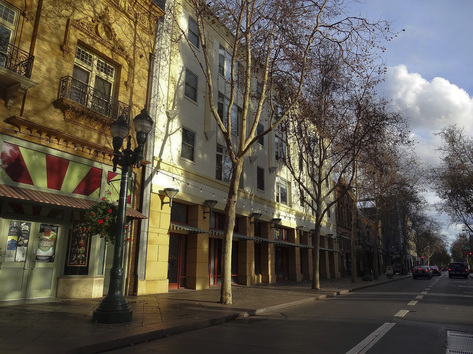
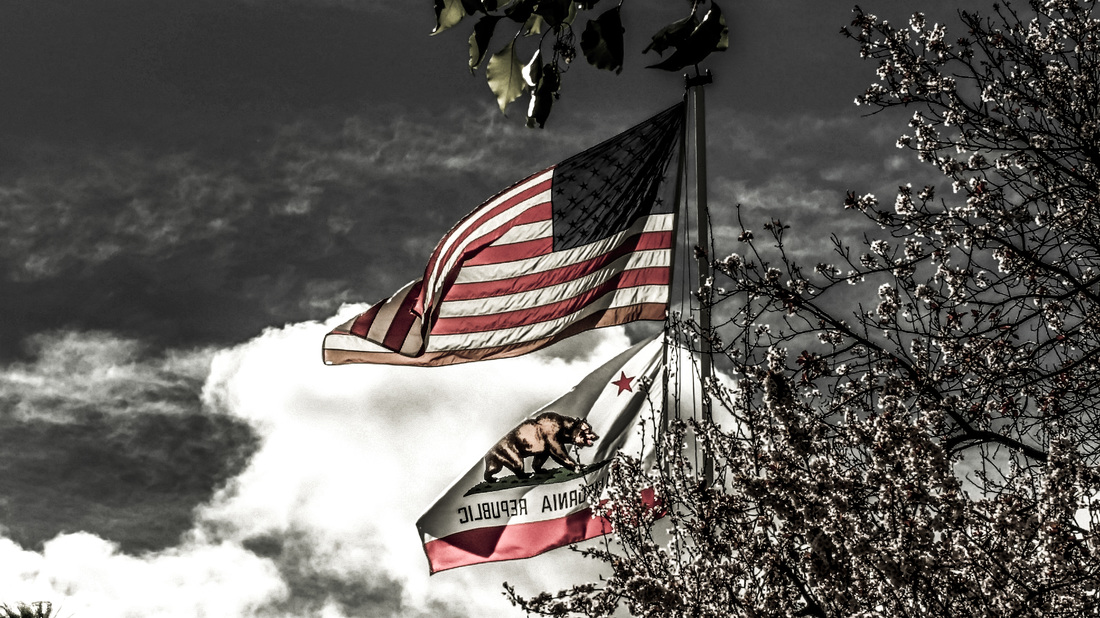
This was one of the first photos I took for the class this year, for our first photo assignment (rules of composition) way back in September. I think this is my transformative photo for several reasons, both personal and technical. The first was that the photo really made me realize that I loved the natural element of the photo (the tress, plants, clouds, etc.), and from then on, the focus of a lot of my work became natural elements in the photo. The second reason is that I realized that viewpoint is crucial to creating a good photo; from then on I experimented with my photos, trying to find viewpoints that capture the essence of the scene and emphasize certain parts of my photos.
5. Shapes are closed objects in a photo; they are two-dimensional and flat, so they express length and width. Forms, on the other hand, are three-dimensional objects, similar to shapes, but expressing length, width, and height.
Blog Posts: Shape Form
6. Pattern means that a certain object, such as a shape or line, is repeated throughout the photo or work of art. Repetition is what gives the pattern meaning; it is essentially how the object is repeated. Repetition works with pattern to give the photograph homogeneity.
All my principles of design photos are included in this post.
7. HERE is a link to my Weebly About Page.
HERE is a link to Ralph Clevenger's About Page, who inspired a great deal of my nature-oriented photographs.
8. Last 3 Projects:
First Commercial Photoshoot
Relay for Life Photoshoot
Final Project - Nature Photoshoot
My best project was probably my last one, the nature photoshoot that I did for the final project. Because I photographed subjects I was familiar with, I was able to find viewpoints for my photos that really showcased the beauty of the plants as well as the majesty of the landscapes. I also made good use of my rules of composition, namely depth of field and viewpoint, particularly for the flower photos, as well as Mr. Farley's #1 rule (getting close), which I know understand.
This project really changed my viewpoint on photography. I realized that, especially for the sunsets, you may have to wait for just the right moment, and that moment could very well pass you by if you aren't paying attention. The sun sets fast, and I missed the right moment two days in a row. Also, always have your camera, because you never know what you may see.
I also learned to see differently, particularly in regards to lighting. In many of my photos, the sun was one of the most important parts of my photo. In nature, the only light you may have is the sun, and some days just don't have the right lighting to capture the photo.
Wednesday, June 10, 2015
Friday, June 5, 2015
Friday, May 29, 2015
Student Website Reviews
1st Period:
Rudy Estrada's best photo is this one; he uses the rule of thirds and establishes depth of field, focusing on the tree closest to the camera.
2nd Period:
William Shih's best photo is this one; he uses leading lines and has excellent space, in addition to his fantastic lighting for the photo.
3rd Period:
Barry Liu's best photo is this one; his excellent use of filters and contrast emphasizes the red and freedom.
4th Period:
Alyssa Zhao's best photo is this one; the photograph has a good amount of space, and her masterful use of color emphasizes the clouds.
Rudy Estrada's best photo is this one; he uses the rule of thirds and establishes depth of field, focusing on the tree closest to the camera.
2nd Period:
William Shih's best photo is this one; he uses leading lines and has excellent space, in addition to his fantastic lighting for the photo.
3rd Period:
Barry Liu's best photo is this one; his excellent use of filters and contrast emphasizes the red and freedom.
4th Period:
Alyssa Zhao's best photo is this one; the photograph has a good amount of space, and her masterful use of color emphasizes the clouds.
Thursday, May 28, 2015
Final Project Proposal
My project is a nuture-oriented photoshoot, with shots of flowers, trees, and horizons. My project is inspired by Ralph Clevenger's style.
The first shot will be of a flower and the sun shining on it. It will be surrounded by similar flowers, which will be out of focus.
The second shot will be another flower shot, but it will be a top view, similar to many images that can be found on Google.
The third shot will be a tree shot; I would like to have an old mossy tree be the focus of the photo, and try to get the light shining through the leaves.
The fourth shot will likely be a landscape photo of the Mission Hills and the meadows that are found on them.
The last shot will be another landscape shot, but this one will be of a horizon, most likely above Mission Peak. I will do it on a somewhat cloudy day to get desired lighting.
The first shot will be of a flower and the sun shining on it. It will be surrounded by similar flowers, which will be out of focus.
The second shot will be another flower shot, but it will be a top view, similar to many images that can be found on Google.
The third shot will be a tree shot; I would like to have an old mossy tree be the focus of the photo, and try to get the light shining through the leaves.
The fourth shot will likely be a landscape photo of the Mission Hills and the meadows that are found on them.
The last shot will be another landscape shot, but this one will be of a horizon, most likely above Mission Peak. I will do it on a somewhat cloudy day to get desired lighting.
Thursday, May 21, 2015
Friday, May 8, 2015
First Commercial Shoot
Ralph Lauren was our inspiration for this shoot:
Taken by Hugh Smith
Taken by Simar Chhabra
Taken by Barry Liu
Taken by Simar Chhabra
Taken by Barry Liu
This is the photo we based our photos off of:
Wednesday, April 29, 2015
Thursday, April 23, 2015
And the Winner for Best Picture
Tuesday, April 21, 2015
Photo Story MCW
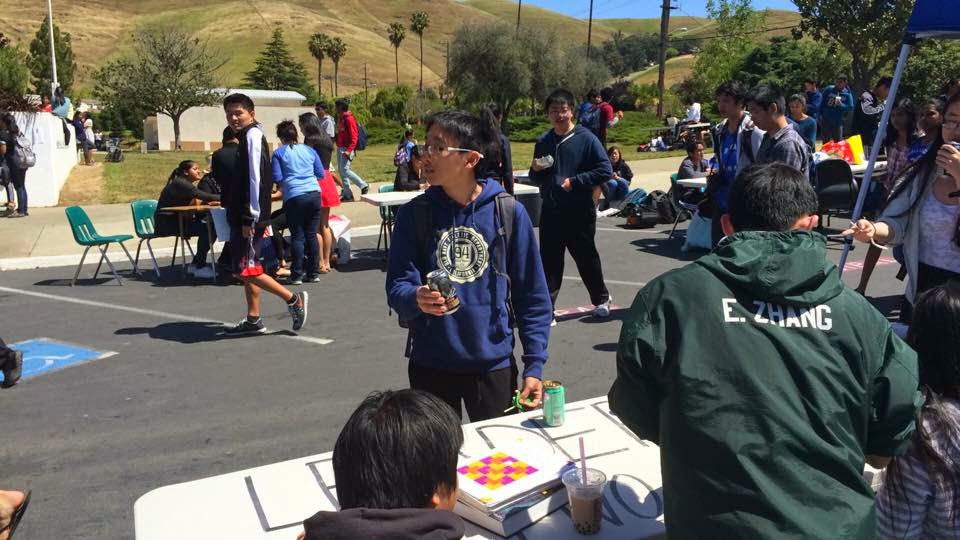
Here we have Andrew Chen, a junior, a physics olympiad champion, and a coding legend. Let's follow him around multicultural week and see how he lives the life.
Andrew has gotten out of class early and is ready to roll. He finishes a leftover soda from yesterday, and checks his wallet to see what he can buy.
As lunch begins on this Tuesday afternoon, Andrew is already ahead of the crowd, having bought his food tickets. As he quickly scans the booths to check for good food he may have missed, his mind is focused on upcoming AP exams and robotics competitions.
Not finding anything good, in the end Andrew has settled for another soda. He will need the energy to get through the rest of his school day.
As the bell rings, Andrew is in the midst of a heated conversation with fellow physics legends Alan Shen and Jerry Yu. They are discussing the nature of quantum locking, a levitation phenomenon that occurs when a super-cooled superconductor is exposed to a magnetic field.
Thursday, April 16, 2015
Story with a photo - Bike Ride of Fate
I stumbled across the setting for this quite by accident; I was riding my bike along a favorite trail near my house, looking for cool plants to photograph for Phoenix Magazine at the request of a friend. Not finding any, I was ready to turn back and look elsewhere, when I opted to ride up a nearby hill for fun. I rode to the top, and not realizing I was standing at the edge of a small cliff due to tall grass and weeds, I suddenly lost my footing, and tumbled 20 feet, fortunately landing in a clump of relatively soft plants. I slowly sat up and realized I was surrounded by beautiful flowers of many colors - red, yellow, orange, but most of all, purple. I immediately knew that I had my picture. After snapping several shots, I now had the problem of getting back up the cliff to where my bike was lying on its side; a painful half hour later, I was on my way back home. It wasn't until I got home that I realized how many cuts and bruises I was covered with.
Wednesday, April 15, 2015
MSJMCW Story
Multicultural week has something for everyone, whether it be the food, the fancy clothes, the extended lunch, or have a chance to show their talents in public...or that's what we're led to believe. Multicultural week is, in fact, a poorly-organized excuse for clubs to sell food and make money. There are very few people who still celebrate the meaning of multicultural week. Take my friend Boyu, for example. "Oh, Multicultural week is just an excuse for those not fortunate enough to have their [driver's] license to get some food...no one really cares about the multi-cultural aspect anymore. It's basically bs," he says.
The ticket lines and ridiculous prices are simply too inconvenient for even the food to be appreciated by many upper-classmen, for whom the extended lunch is a blessing. "It gives us a chance to drive farther than normal, with less time pressure," says veteran lunch-driver Taasin Saquib. "Like, normally our options for lunch are really limited, but like we can go a lot of places during multicultural week."
Simply put, the poorly-organized multicultural week is no longer the tradition it was...now, people only care about it for the food and extra time. In a way it's sad, but at the same time, it can help to strengthen friendships to last the test of time.
Thursday, April 2, 2015
Shutter Speed and Everything After
Paired with Ethan Hu & Anita Yen
1. The photo of the truck demonstrates a fast shutter speed, because the photo appears frozen. Since the trucks are on a highway and should be moving, the fact that they are frozen and not blurry means that the photographer used a relatively fast shutter speed.
2. The photo employs the Rule of Viewpoint to capture all 3 trucks in such a way that emphasizes the lines and the color of the trucks.
Ethan's Rule is the Rule of diagonals. For more info, look here.
3. The photo employs the element of lines. The barrier in the middle, as well as the highway lanes, all are parallel lines.
4. The photographer employed emphasis in the photo. The comparison of the brightly-colored truck to the pale and gray background causes it to stand out, and places emphasis on it as the subject of the photo.
1. The photo of the truck demonstrates a fast shutter speed, because the photo appears frozen. Since the trucks are on a highway and should be moving, the fact that they are frozen and not blurry means that the photographer used a relatively fast shutter speed.
2. The photo employs the Rule of Viewpoint to capture all 3 trucks in such a way that emphasizes the lines and the color of the trucks.
Ethan's Rule is the Rule of diagonals. For more info, look here.
3. The photo employs the element of lines. The barrier in the middle, as well as the highway lanes, all are parallel lines.
4. The photographer employed emphasis in the photo. The comparison of the brightly-colored truck to the pale and gray background causes it to stand out, and places emphasis on it as the subject of the photo.
Photo with Farley's Kids
Shutter Speed of 1/250
Friday, March 27, 2015
Friday Lens Photo Variety
The photo from the slideshow that best illustrates the principle of variety is photo 15. The use of lines in the roof, combined with the space behind the man and the texture of the singer's clothes yield the impression of motion, and give the photo a variety of places for the eye to focus. Each part of the photo gives off a different impression of the overall feel, demonstrating variety.
Top kek.
Top kek.
Tuesday, March 24, 2015
Movie Monday Part 3-4
1. I define my vision of success as the accomplishment my major goals; this includes, but is not limited to, graduation from college with a degree in engineering, obtaining a commercial pilot license, and employment in NASA as an aeronautical engineer.
2. I have had to sacrifice much of my time in my youth in order to obtain the education I need to accomplish these goals.
3. Parks had to give up time with his family and the opportunity to make money.
4. He was the founder of the UN.
5. He was initially offered 5K, but that increases to 10K.
6. He offered Parks $500 Million.
7. He did not want Muhammad altering the story.
8. It was the first Hollywood film directed by a black man.
9. He was a hero for young African Americans, who could relate to him; he went beyond the limits of society and the boundaries of race.
10. Parks used the camera and the pen.
11. She said she was unable to keep up with Parks' busy life.
12. "12 Years a Slave"
13. He was Parks' son, who became a famous film director as well.
14. My favorite photo is the one of the young boy whom Parks would later rescue.
15. I will remember that Parks is the embodiment of a value system; he fought for what he believed in, and he worked hard to get where he was. I will remember him not as a photographer, but as a human being.
2. I have had to sacrifice much of my time in my youth in order to obtain the education I need to accomplish these goals.
3. Parks had to give up time with his family and the opportunity to make money.
4. He was the founder of the UN.
5. He was initially offered 5K, but that increases to 10K.
6. He offered Parks $500 Million.
7. He did not want Muhammad altering the story.
8. It was the first Hollywood film directed by a black man.
9. He was a hero for young African Americans, who could relate to him; he went beyond the limits of society and the boundaries of race.
10. Parks used the camera and the pen.
11. She said she was unable to keep up with Parks' busy life.
12. "12 Years a Slave"
13. He was Parks' son, who became a famous film director as well.
14. My favorite photo is the one of the young boy whom Parks would later rescue.
15. I will remember that Parks is the embodiment of a value system; he fought for what he believed in, and he worked hard to get where he was. I will remember him not as a photographer, but as a human being.
Wednesday, March 11, 2015
Principles of Design
Principles of Design Assignment
*Note: this post will be continuously updated as more photos are taken
Balance:
Balance is the even distribution of the objects and elements in a photo.
Emphasis:
Emphasis is the focus of the photo.
Movement:
Movement is how the viewer's eye moves through the photo.
Pattern/Repetition:
Pattern is the repeated use of an object. Repetition is how the pattern is organized in the photo.
Proportion:
Proportion is the correct relation between the sizes of the elements/objects in the photo.
Rhythm:
Rhythm is the repeated use of elements of art to organize movement in the photo.
Friday, March 6, 2015
Thursday, March 5, 2015
Wednesday, March 4, 2015
Space in Plant Life
Before:
After:
In Camera Raw, I raised the values of the shadows and raised the vibrance. I also raised the clarity a little.
Tuesday, March 3, 2015
Subscribe to:
Posts (Atom)